Also check out BASICS PRINCIPALS OF KANGAL TRAINING
Also check out OWNING KANGAL DOGS
The breed
standard I. International Symposium of Kangal Dog
Head:Skull large, broad and flat between the
ears. Slight furrows between the eyes and slit.
Mature males have broader heads than females.
Foreface: the muzzle should be one third of total head
length. Slightly pendulous black lips. Square profile.
The head is where you have to be careful. If you breed only
for one thing, such as big heads, you will produce dogs that are out of
proportion and ugly. Dogs with heads that are too big usually have a lot of
loose skin on the face, which can cause eye problems, or, around the muzzle,
causing excessively loose lips and constant drooling - like a St. Bernard. So the head is big but
clean cut without excessive loose skin.
Eyes: Rather small in proportion to head size. Showing no haw (redness). Set well apart and deep. Golden to brown in color.
Eyes seemed to have evolved with the dog for the climate.
Can you imagine a dog with big round eyes in a dust storm in summer, or a snow
blizzard in winter? So ideally the eyes are small and almond shaped.
Mouth: Teeth strong with a regular, scissor bite. That is
the upper teeth closely overlapping the lower teeth and set
square to the jaws.
I have found
that most of these dogs have very large, strong teeth with a scissor bite, but
dogs, especially males with a strong, short muzzle, have a level bite and I
think it is more natural for that kind of bite in these dogs.
Body: Chest deep to point of elbow, ribs well sprung. Body powerful. Well muscled - never fat. Level back. Body in proportion to leg length, with good tuck up.
It is important that the Karabas/Kangal is never fat except in puppies or older dogs. it must
not be too thin either and should be very well muscled.
The body is slightly longer than the height at the shoulder.
Feet: Strong feet with well arched toes, nails short. The feet should be large but well formed and neat. They
should not be flat or splayed (spread). Nails blunt.
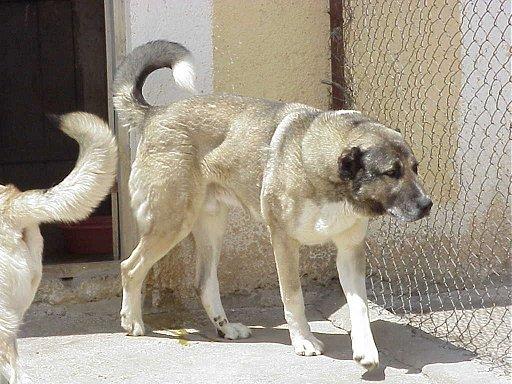
Tail: Set on rather high. When relaxed carried low sometimes
with slight curl or hook. When alert carried high with end curled over back.
The tail is one of the most distinctive features of the
breed and sets it apart from all other large dogs.
The curl can be anything from a loose scimitar shape over
the back to a tight ring tail on the back and many variations in between.
Whatever the curl is it must always be on the centre of the
back and not fall to either side of the hip like an Akita or spitz type. This is most important to differentiate the Karabas/Kangal from any of the spitz breeds.
Coat: Short and dense, with thick undercoat. Flat, close
lying, neither fluffy nor wavy, slightly thicker at neck,
shoulders and tail, especially in males. No feathering on ears, legs or
tail.
The coat is important and has again been shaped by the
environment and life style. Here we have a weather proof, dust proof coat that
is self-cleaning and virtually odorless. It has a
soft, thick, weatherproof undercoat
to keep out frost and wind The outer coat is waterproof and harsh to the touch.
The undercoat sheds heavily twice yearly.
Occasionally long haired pups with heavy coats or long
haired silky coats will appear in a litter, but they are not the norm. As they
appear so scarcely, and in some lines not at all, it is obvious that the short
coat is correct.
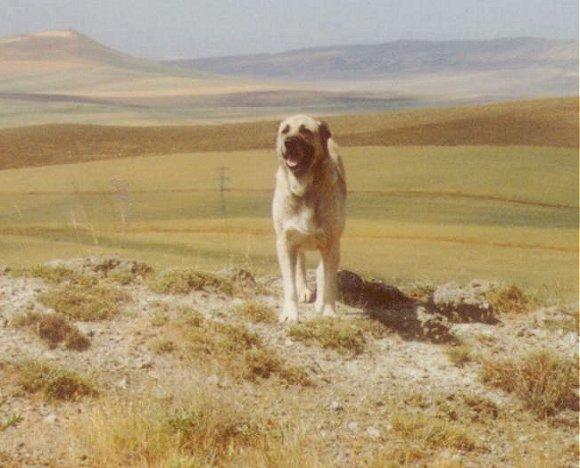
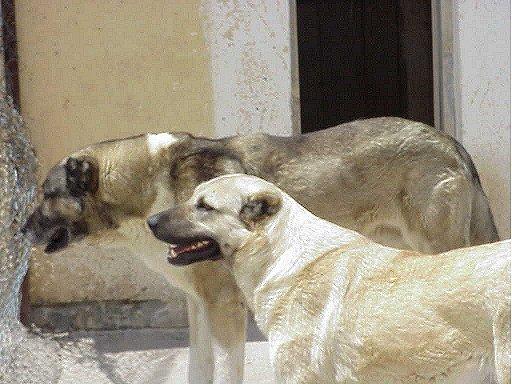
Color: All colors acceptable but it is desirable that they
are whole colors, cream to fawn, with black mask and ears.
This is probably the most important factor in the breed. If
the coat color is right then it usually follows that the rest of the dog will
be right: not a hundred percent of the time, but almost.
Black head and ears are the most distinctive feature and
probably goes back to the primitive Mastiffs that fought in the Roman arenas
and were dogs of war. The primitive Mastiff was in fact very similar to your Karabas/Kangal of today.
The body colors can be from palest cream through yellow,
gold, fawn and red to grey. It has to be possible that brindle is also part of
the color pattern and I have in fact seen several brindles in Turkey but have
never bred one. Genetically the color combination of black mask and fawn will
usually also breed striped brindles as in the Pug, Boxer and Bullmastiffs, or
even solid blacks, maybe. The black head or mask can be from deep black face
and ears to a slight shading on the muzzle and ears.
Obviously, a black head is very desirable.
Size: For mature dogs, males are from 50 kg to 64 kg.
Females are from 41 to 59 kg. Height is: males 74 - 8 1 cm. Females 7 1 79 cm.
The size of a Karabas/Kangal is
sometimes exaggerated out of all proportion. It is a big dog but it is not
huge, it is just a big dog. The memorable thing about the size of the Karabas/Kangal is that he always looks bigger than he is, especially to strangers.
When breeding for size always remember that this is also a ‘running’ dog and he
has to be fast enough to catch his wolf. We have clocked them at 30 miles an
hour and still lost them. |